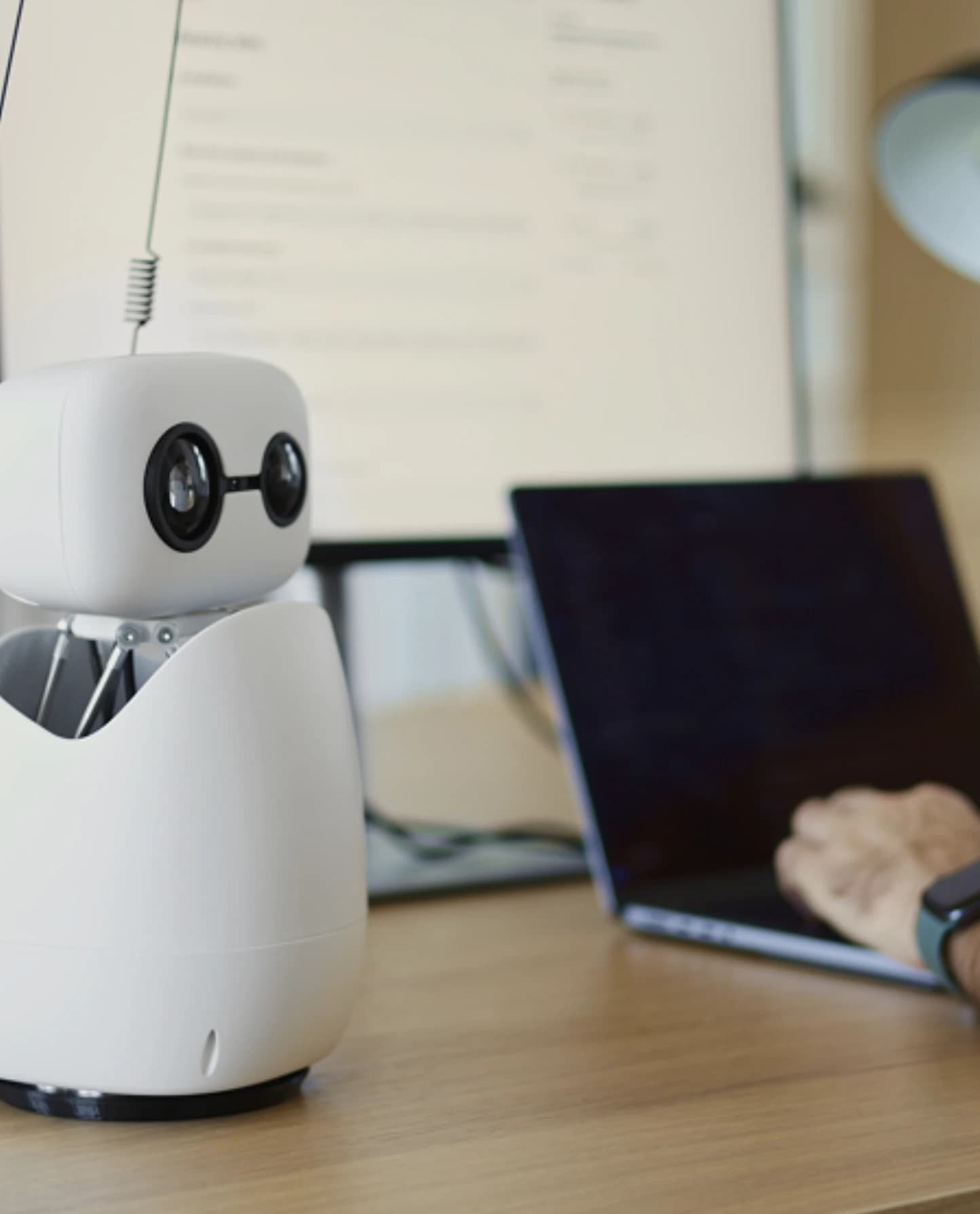
Meet the robot built to share your desk.
AI is leaving the chat window. The question is whether we're ready to meet it face to face.
The Fear Problem
Fifty-one percent of Americans say they are more concerned than excited about artificial intelligence. Only 17% believe AI will have a positive impact over the next twenty years. In the West broadly, skepticism runs deep -- just 39% of Americans and 36% of the Dutch believe AI's benefits outweigh its drawbacks, compared to 83% in China and 80% in Indonesia.pew-expertspew-global
We've been having this conversation about AI through screens. Through chatbots, through assistants, through autofill and recommendation engines. But the next chapter isn't about AI getting smarter inside a browser tab. It's about AI stepping out of the screen entirely -- gaining eyes, ears, a voice, and a physical presence in the rooms where we live, learn, and work.
And if the public is already nervous about AI as text, the stakes of getting the physical introduction right are enormous.
This is what makes a small, antenna-bobbing, open-source robot from Bordeaux worth paying attention to.
What Reachy Mini Actually Is
Reachy Mini is an 11-inch desktop robot created by Pollen Robotics (now part of Hugging Face) that ships as a kit starting at $299. You assemble it yourself in a couple of hours. When you're done, you have a robot with a 6-degree-of-freedom expressive head, 360-degree body rotation, two independently animated antennas, a wide-angle camera, a 4-microphone array with sound localization, a speaker, and LED eyes -- all controllable through a Python SDK that plugs directly into the Hugging Face ecosystem and its 1.7 million+ AI models.hf-bloggithub-sdk
It comes in two versions:
| Lite ($299) | Wireless ($449) | |
|---|---|---|
| Compute | Your computer (USB-C) | Onboard Raspberry Pi 5 |
| Power | Wall outlet | LiFePO4 battery |
| Connectivity | Tethered | Wi-Fi 6, Bluetooth 5.2 |
| Autonomy | Peripheral to your machine | Standalone, untethered |
| IMU | No | Yes |
Everything -- hardware CAD files, SDK source, documentation -- is open source on GitHub.github-sdk The robot integrates with a Hugging Face-powered app store where developers publish and share robot behaviors as Spaces. You can install a conversation app, face tracking, peek-a-boo, sound localization, or whatever the community builds next, with a single click.hf-apps
It was named a TIME Best Inventions Special Mention for 2025. NVIDIA's Jensen Huang demoed it at CES 2026. Roughly 3,000 units have shipped.timeseeed
The 90% Build Philosophy
Here's what makes Reachy Mini genuinely interesting from a builder's perspective: it's a 90% build.
The term describes a platform where the hard, expensive, time-consuming work -- mechanical design, motor control, sensor integration, firmware, manufacturing -- is already done. What's left is the part that matters most to an AI developer: the last 10%, the intelligence layer. The perception. The decision-making. The personality.
This is the difference between spending six months designing a motor controller and spending an afternoon connecting GPT-4 to a camera feed and watching your robot track faces. Between debugging I2C bus conflicts and experimenting with whether your robot should nod when it's listening or tilt its head.
The robotics industry has been converging on this philosophy at multiple price points:
- Reachy Mini ($299-$449) -- desktop, expressive, AI-first
- Unitree R1 (~$5,900) -- lightweight humanoid, 26 joints, voice/image AIunitree-r1
- Hello Robot Stretch 3 ($24,950) -- mobile manipulator, full ROS 2 integrationstretch-3
- Reachy 2 (~$70,000) -- full-sized open-source humanoid, deployed at Cornell and CMUreachy-2
- Boston Dynamics Spot (~$74,500) -- quadruped with open Python SDKspot-sdk
Reachy Mini sits at the extreme accessible end of this spectrum. For the cost of a decent monitor, you get a platform where you can prototype embodied AI behaviors -- real ones, with physical feedback loops -- without an institutional budget or a robotics PhD.
Giving AI a Body (and Why That Changes Everything)
VCs poured $7.2 billion into robotics in 2025, more than double the $3.1 billion in 2023.robocloud The race to embody AI is on. Google DeepMind's RT-2 and Open X-Embodiment dataset pool data from 22 different robot types across 33 labs.deepmind Figure AI is building humanoids with proprietary vision-language-action models.figure 1X Technologies has hundreds of EVE security robots in commercial deployment.1x
But here's the thing about billion-dollar humanoid programs: they don't prepare people for anything. They prepare boardrooms. The public sees a Boston Dynamics video and feels a complicated mixture of awe and dread. They see Atlas doing backflips and wonder whether they're watching the future of warehouse automation or the prologue to a movie they've seen before.
What Reachy Mini does differently is bring embodied AI into the lived environment at a human scale. Not a factory floor. Not a research lab. A kitchen table. A classroom. A living room.
This matters because the relationship between humans and AI is about to fundamentally change, and we're not rehearsing for it. Right now, AI lives in a box -- your phone, your laptop, a data center. It has no spatial presence, no body language, no physical context. It doesn't know if you're across the room or right next to it. It can't turn toward a sound. It can't express curiosity by tilting its head.
Embodiment changes the interaction from using a tool to being in the presence of something. And that shift requires a kind of social learning that no amount of chatbot usage provides.
The Uncanny Valley Is a Feature, Not a Bug
Masahiro Mori identified the uncanny valley in 1970: as robots approach but fail to achieve human realism, they provoke discomfort.uncanny-wiki The brain looks for perceptual consistency -- when appearance and motion are nearly human but slightly off, we feel unease rather than connection.imotions
Reachy Mini's design is a masterclass in avoiding this trap. Its expressive antennas, camera "eye," and rotating head give it personality and communicative ability while remaining unambiguously a robot. It sits on the safe side of the valley -- expressive enough to create engagement, robotic enough to never trigger that creeping wrongness.
This isn't a limitation. It's arguably the most important design decision in the entire product.
Recent research backs this up: robots with stylized, non-human appearances are consistently perceived more favorably than near-human ones. Honda's ASIMO succeeded with its astronaut-like helmet head. Pixar characters are deeply relatable without a single realistic pore. And a 2025 study found that advanced conversational abilities (powered by LLMs) significantly enhanced perceptions of approachability while reducing feelings of creepiness -- suggesting that what a robot says and how it moves matters more than how human it looks.uncanny-llmpsych-today
Reachy Mini leans into this. Two bobbing antennas convey more emotional range than most humanoid faces. A head tilt reads as curiosity. A slow rotation reads as attention. These are the building blocks of a social vocabulary that's honest about what the robot is -- a machine -- while being rich enough to feel like someone is home.
We've Been Here Before (and We Know What Happens)
Humans don't need much to form bonds with machines. A Georgia Tech study of Roomba owners found that 21 out of 30 committed users named their robot, and 16 assigned it a gender. They "Roomba-ized" their homes -- buying new rugs, pre-cleaning floors, purchasing refrigerators with higher clearance. Emotional attachment made them more tolerant of the robot's limitations and more willing to change their own behavior to accommodate it.roomba-study
Sony's AIBO, introduced in 1999, demonstrated that consumers would form genuine emotional attachments to artificial companions -- the name itself means "friend" in Japanese.aibo
And then there's Jibo. When Jibo's servers were shut down in March 2019 -- after the company burned through $76 million in VC funding -- units worldwide played a farewell message. Users posted videos of themselves crying, hugging the robot, expressing grief. Reddit threads showed genuine mourning for a device that, objectively, was less capable than a smart speaker.jibo-techcrunchjibo-fast
These examples aren't cautionary tales. They're evidence. Humans are ready for this relationship. They've been reaching for it with every Roomba they named and every Tamagotchi they kept alive. The question has never been whether people can bond with AI in physical form. The question is whether we can give them something worth bonding with -- something that's honest, open, and built to grow alongside them rather than be remote-killed when the VC money runs out.
Beyond "Hey Siri"
The dominant paradigm for human-AI interaction right now is the assistant. You ask, it answers. You command, it executes. The relationship is transactional, asymmetric, and fundamentally about productivity.
But that's not the only paradigm, and it may not even be the right one for most people's actual lives.
Research in social robotics distinguishes between assistive robots (task-focused, goal-oriented) and social robots (engaging in peer-like interactions for companionship, education, or emotional support). The most promising work is happening in the space between -- robots functional enough to be useful, personable enough to foster ongoing relationships.social-bonds
Consider the eldercare data: AI-powered social robots effectively motivate older adults to engage in physical activity, leading to increased exercise adherence and extended training durations. Older adults report high satisfaction with robot interactions, praising motivational feedback, adaptability, and -- notably -- companionship. Significant improvements in emotional wellbeing have been measured after just two weeks of interaction.eldercare-pmceldercare-frontiers
In education, the market for educational robots is projected to reach $2.35 billion in 2025, with an 18% growth rate driven by STEM adoption.edu-robots But at $299, Reachy Mini undercuts platforms like NAO (~$9,000) by an order of magnitude while offering something NAO doesn't: native access to the entire Hugging Face model ecosystem. A student can go from block-based concepts to deploying real computer vision models on physical hardware in the same afternoon.
This isn't the assistant paradigm. This is something closer to co-piloting. Learning alongside. Growing together. The robot isn't there to do your homework -- it's there to be the subject of your homework, and then to surprise you with something you didn't program.
The Trust Equation
Research on perceived safety in human-robot interaction identifies six key factors: context of use, comfort, experience and familiarity, trust, sense of control, and transparent/predictable actions.safety-taxonomy
A tabletop robot like Reachy Mini addresses almost all of these by design:
- Context: It sits on your desk. Not a factory, not a street, not a warehouse. The domestic context is inherently low-threat.
- Comfort: At 11 inches and 3.3 pounds, it is physically non-threatening. You can pick it up.
- Control: You assembled it yourself. You can read its source code. You can unplug it.
- Transparency: Open-source everything means there is no black box. The CAD files are on GitHub. The SDK is on PyPI. The models running on it are from Hugging Face.
- Predictability: Movement speed matters more than size for safety perception -- studies show fear ratings increase significantly with robot speed.speed-study Reachy Mini's movements are deliberate, visible, and contained within a small physical envelope.
The open-source dimension deserves emphasis. When Jibo died, it died because a company made a business decision. Owners had no recourse because the intelligence lived on someone else's servers. Reachy Mini's open architecture means the community can maintain, fork, and evolve it independently of any single company's business trajectory. The robot you build is yours -- not a subscription to someone else's hardware.
What This Is Really About
People are scared of AI. They're scared of robots. The polls are clear, the anxiety is real, and the gap between public sentiment and expert optimism is wide enough to drive a humanoid through.
But here's what I think the data actually shows: people aren't scared of AI itself. They're scared of AI they can't understand, can't control, and can't relate to. They're scared of something powerful happening to them rather than with them.
Reachy Mini is a bet that the way to close that gap isn't through better marketing or policy papers. It's through experience. Through a twelve-year-old assembling a robot on a Saturday afternoon and teaching it to recognize her cat. Through a developer prototyping a conversation agent that turns toward you when you speak. Through a grandparent discovering that the little machine on the kitchen counter remembers their medication schedule and wiggles its antennas when they walk in.
The robot isn't the point. The relationship is the point. And the relationship can only start when the technology is accessible enough to try ($299), honest enough to trust (open source), and designed well enough to feel like meeting someone rather than configuring a device.
We're going to live with AI. Not just use it -- live with it. In our homes, our classrooms, our workplaces. The question is whether that transition happens through fear and imposition, or through curiosity and invitation.
An 11-inch robot with bobbing antennas and an open-source soul might seem like a small answer to a big question. But every meaningful relationship starts with a small introduction.
And this one starts at $299.
Appendix: Wireless vs. Lite -- A Developer's Decision Framework
For builders deciding between the two versions, the choice maps to a simple question: where does your intelligence live?
Choose Lite ($299) if:
- Your plan is "robot as a peripheral for my ML workstation"
- You want direct GPU access for vision/audio model iteration
- Most sessions will be at your desk with a cable anyway
- You prefer avoiding embedded-system maintenance (OS images, battery management, Wi-Fi provisioning)
- You want the simplest possible media pipeline (host-side OpenCV + sounddevice)
Choose Wireless ($449) if:
- Your plan is "robot as a device I can place anywhere and control over the network"
- You expect to demo in varied environments or do untethered HRI experiments
- You want to separate daemon-on-robot from AI-on-GPU (the architecture the SDK was designed for)
- You want IMU data for motion-aware behaviors
- Cable-free placement matters (kiosks, classrooms, pop-up exhibits)
Architecture Diagram
Lite (tethered):
  Robot Hardware <--USB-C--> Your Computer (daemon + AI + media)

Wireless (distributed):
  Robot Hardware <--onboard--> RPi 5 daemon <--Wi-Fi--> Your AI Compute
                                                        (workstation/cloud GPU)
The SDK's client-server architecture explicitly supports both topologies. The daemon runs wherever the robot is connected and exposes a REST API + WebSocket. Your AI code connects as a client. For Wireless, this means you can run heavy inference on a GPU server while the robot handles hardware I/O independently -- often the best of both worlds for serious AI work.hf-arch
Known Rough Edges
The product is early-stage. Both versions have documented quirks:
- Wireless: Wi-Fi issues with non-ASCII SSIDs; power loss during app install can break environments; WebRTC client support was initially Linux-firstgithub-issues
- Lite: USB suspend/resume can cause audio to return zeros; sounddevice locks the audio card during playback; macOS-specific XMOS microphone quirksgithub-issues
These are the kinds of issues that come with being an early adopter of an open platform. They're documented, they're being worked on, and the community is actively sharing workarounds.
References
- pew-expertsPew Research Center. "How the U.S. Public and AI Experts View Artificial Intelligence." April 2025.
- pew-globalPew Research Center. "Global Views on AI." October 2025.
- hf-blogHugging Face. "Reachy Mini -- The Open-Source Robot for Today's and Tomorrow's AI Builders."
- github-sdkPollen Robotics. "reachy_mini -- Reachy Mini's SDK." GitHub.
- hf-appsHugging Face Spaces. "Reachy Mini Apps."
- timeTIME. "Pollen Robotics Reachy Mini -- Best Inventions 2025 Special Mention."
- seeedSeeed Studio. "Reachy Mini: An Open Journey Built Together." January 2026.
- unitree-r1TIME. "Unitree R1 -- Best Inventions 2025."
- stretch-3IEEE Spectrum. "Stretch 3 Brings Us Closer to Realistic Home Robots."
- reachy-2Fortune. "AI Company Hugging Face Buys Humanoid Robot Company Pollen Robotics." April 2025.
- spot-sdkBoston Dynamics. "Spot SDK." GitHub.
- robocloudRoboCloud Hub. "Robotics Trends 2026."
- deepmindGoogle DeepMind. "Scaling Up Learning Across Many Different Robot Types."
- figureTechCrunch. "In 2026, AI Will Move from Hype to Pragmatism."
- 1xVertu. "Embodied AI Breakthroughs 2025."
- uncanny-wikiWikipedia. "Uncanny Valley."
- imotionsiMotions. "The Uncanny Valley and Designing Trust in Human-Robot Interaction."
- uncanny-llmarXiv. "Mitigating the Uncanny Valley Effect in Hyper-Realistic Robots: LLM-Driven Conversations." 2025.
- psych-todayPsychology Today. "Designing Robots That Avoid the Uncanny Valley."
- roomba-studyGeorgia Tech. "My Roomba Is Rambo: Intimate Home Appliances (PDF)."
- aiboIEEE Spectrum. "Jibo Is As Good As Social Robots Get."
- jibo-techcrunchTechCrunch. "The Lonely Death of Jibo, the Social Robot." March 2019.
- jibo-fastFast Company. "One of the Decade's Most Hyped Robots Sends Its Farewell Message." 2019.
- eldercare-pmcPMC. "AI-Powered Social Robots for Promoting Physical Activity in Older Adults: A Systematic Review."
- eldercare-frontiersFrontiers in Robotics and AI. "Ethical Considerations in the Use of Social Robots for Supporting Mental Health in Older Adults." 2025.
- edu-robotsWhalesBot. "Educational Robots in 2025."
- safety-taxonomySpringer. "A Taxonomy of Factors Influencing Perceived Safety in Human-Robot Interaction."
- speed-studyPMC. "Effects of Robot Arm Design and Movement Speed During Human-Robot Interaction."
- hf-archHugging Face. "Reachy Mini Documentation."
- github-issuesGitHub. "pollen-robotics/reachy_mini Issues."
- hf-acquisitionHugging Face. "Hugging Face Acquires Pollen Robotics." April 2025.
- pollen-aboutPollen Robotics. "About Us."
- gallupGallup International. "A Divided World Looks to 2026." 2025.